
Best Local LLMs for Code Generation and DevOps in 2026
Best Local LLMs for Production-Grade Code Generation and DevOps in 2026
Local Large Language Models (LLMs) are becoming increasingly capable of assisting developers with everyday engineering tasks. From generating application code and debugging complex issues to writing Terraform configurations, Kubernetes manifests and CI/CD pipelines, locally hosted AI models offer an interesting alternative to cloud-based AI services.
But which local LLM should you choose if your primary focus is production-grade code generation and DevOps automation?
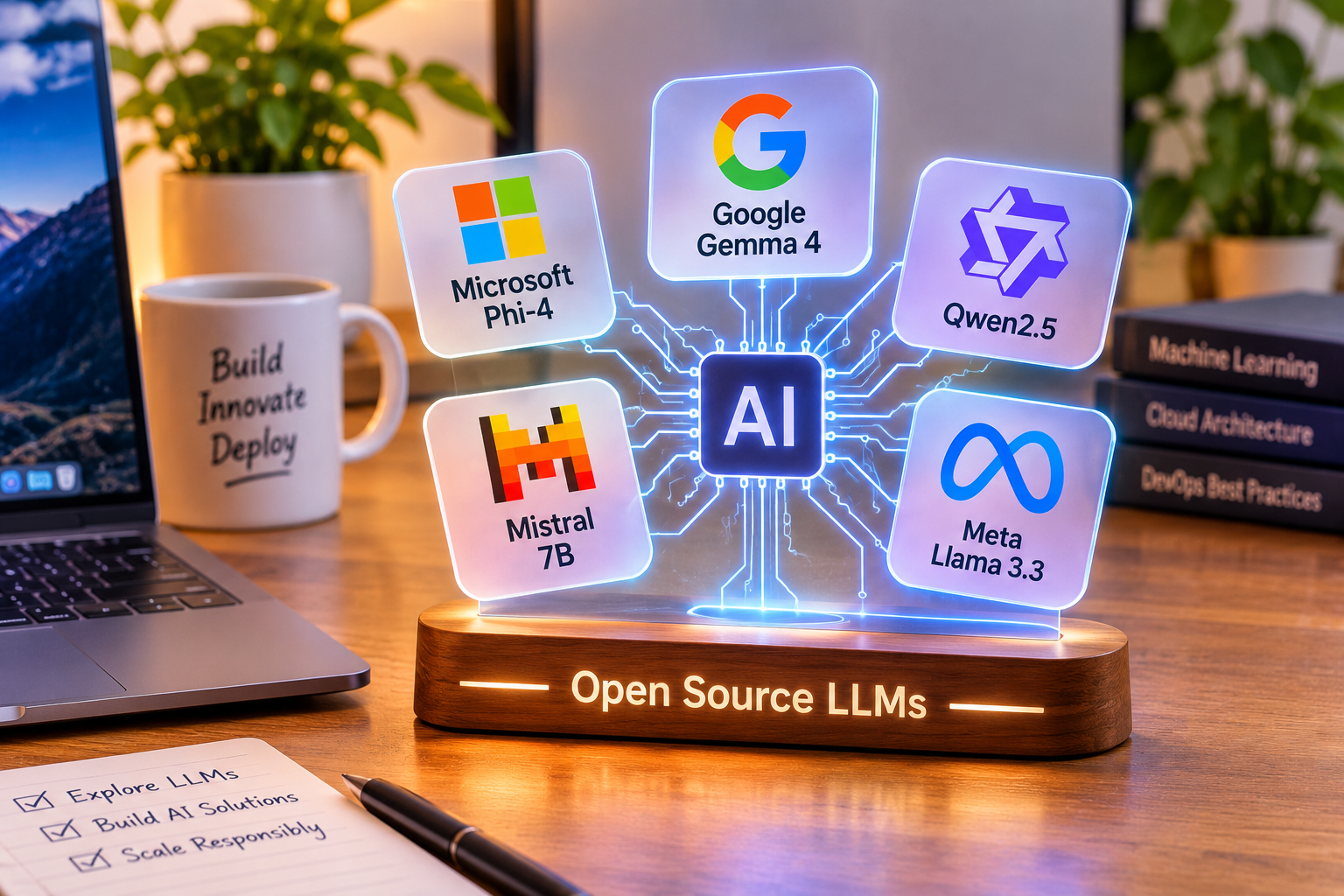
Let’s compare five popular model families:
- Microsoft Phi-4
- Google Gemma 4
- Qwen2.5
- Mistral 7B
- Meta Llama 3.3
1. Microsoft Phi-4
Microsoft Phi-4 is a relatively compact language model designed to deliver strong reasoning capabilities without requiring the infrastructure associated with larger models.
Where it performs well:
- Python, SQL and general-purpose programming.
- Writing smaller automation scripts.
- Technical explanations and troubleshooting.
- Lightweight local AI deployments.
Limitations:
Although Phi-4 offers good reasoning capabilities for its size, it is not my first choice for complex, multi-file software development or sophisticated infrastructure automation.
Verdict: A good option when hardware resources are limited and you need a reasonably capable local assistant.
2. Google Gemma 4
Google Gemma 4 is an attractive option for developers looking for a general-purpose model capable of handling complex reasoning, programming and technical problem-solving.
The larger 31B variant is particularly interesting for software engineering and DevOps workloads.
Where it performs well:
- Generating Kubernetes manifests and Helm configurations.
- Designing AWS infrastructure and EKS architectures.
- Terraform and infrastructure-as-code development.
- Debugging application and infrastructure issues.
- Understanding complex technical requirements.
- Designing distributed systems and microservices.
Limitations:
The larger variants require considerable RAM or GPU memory. You should also validate generated code and infrastructure configurations before using them in production.
Verdict: My preferred choice as a general-purpose local LLM for developers and DevOps engineers.
3. Qwen2.5-Coder
Qwen2.5-Coder, developed by Alibaba, is specifically designed for programming-related workloads.
Unlike general-purpose language models, it focuses heavily on code generation, code completion, debugging and understanding existing codebases.
Where it performs well:
- Java, Spring Boot and microservices development.
- PHP, Python, JavaScript and SQL.
- Generating REST APIs and backend services.
- Code refactoring and debugging.
- Writing Bash and Python automation scripts.
- Generating Dockerfiles and GitLab CI/CD pipelines.
The 32B variant is particularly interesting if you have sufficient hardware resources. Smaller 14B and 7B variants are alternatives for machines with limited resources.
Limitations:
Although it is excellent for programming, complex architectural reasoning and broader infrastructure troubleshooting may benefit from a more general-purpose reasoning model.
Verdict: My preferred choice for code-specialist workloads.
4. Meta Llama 3.3
Meta Llama 3.3 is a general-purpose language model family, with the 70B instruction-tuned model being particularly relevant for demanding workloads.
It offers strong reasoning and language capabilities, making it useful for more than just code generation.
Where it performs well:
- Software architecture discussions.
- Technical documentation.
- Infrastructure design.
- Complex technical explanations.
- General programming assistance.
Limitations:
The 70B variant requires substantial hardware resources. For code-specialist tasks, I would generally prioritise Qwen2.5-Coder.
Verdict: A good general-purpose model, especially when technical reasoning and documentation are important.
5. Mistral 7B
Mistral 7B is a relatively lightweight model that can run on modest hardware.
It is useful for developers who want to experiment with local AI without investing in expensive GPU infrastructure.
Where it performs well:
- Basic code generation.
- Simple Python and Bash scripts.
- Docker Compose configurations.
- Basic Kubernetes YAML.
- Technical explanations.
Limitations:
It is less suitable for complex software engineering tasks, large codebases and multi-step infrastructure troubleshooting compared with the larger models in this comparison.
Verdict: Suitable for lightweight experimentation, but not my preferred choice for production-oriented coding assistance.
6. Overall comparison
Here is my qualitative assessment of these models for software engineering and DevOps workloads.
| Model | Code Generation | DevOps | Reasoning |
|---|---|---|---|
| Gemma 4 31B | Excellent | Excellent | Excellent |
| Qwen2.5-Coder 32B | Excellent | Very Good | Very Good |
| Llama 3.3 70B | Very Good | Very Good | Excellent |
| Phi-4 14B | Good | Good | Very Good |
| Mistral 7B | Average | Average | Average |
These ratings are practical assessments, not results from a controlled benchmark. Performance will vary depending on model variants, quantisation and the tasks being evaluated.
7. My Recommended Local AI Stack
If I were building a local AI development environment for everyday software engineering and DevOps work, I would start with the following setup.
| Component | Technology | Purpose |
|---|---|---|
| Primary LLM | Google Gemma 4 31B | Architecture, reasoning and DevOps |
| Secondary LLM | Qwen2.5-Coder 32B | Code generation and debugging |
| Model Runtime | Ollama | Running local models |
| Web Interface | Open WebUI | Chat interface |
| IDE Integration | Continue | AI-assisted development |
| Coding Agent | Aider | Repository-level coding |
This combination provides a practical foundation for experimenting with locally hosted AI across different engineering workflows.
8. Hardware Considerations
Before downloading a model, consider the hardware requirements.
The following are approximate memory requirements for 4-bit quantised model weights.
| Model | Approximate Memory |
|---|---|
| Phi-4 14B | 9–10 GB |
| Qwen2.5-Coder 14B | 9–10 GB |
| Qwen2.5-Coder 32B | 19–21 GB |
| Gemma 4 31B | 18–20 GB |
| Llama 3.3 70B | 40–45 GB |
These figures represent model weights rather than total runtime memory. Additional memory is required for context, KV cache and inference overhead.
Conclusion
Local LLMs have reached a point where they can be genuinely useful in software development and DevOps workflows.
However, there isn’t necessarily one model that excels at everything.
My recommendation would be:
- Google Gemma 4 31B: For general-purpose development, technical reasoning and DevOps.
- Qwen2.5-Coder 32B: For code generation, debugging and software engineering.
- Llama 3.3 70B: For general-purpose reasoning and technical discussions.
- Phi-4: For smaller hardware environments.
- Mistral 7B: For lightweight experimentation.
One final point: generating production-quality code is not the same as generating production-ready software. Always validate generated code through unit tests, integration tests, static analysis, security scanning and appropriate infrastructure validation before deploying it.
The real opportunity with local LLMs is not simply replacing an online chatbot. It is building an AI-assisted engineering environment where your code, infrastructure and development workflows can be supported by models running on your own hardware.